At a glance
Kyoto has a reputation for closing early. It’s not entirely wrong. But if you know where to go, the city after dark is one of its best rewards. Rooftop bars with views across Higashiyama. Izakaya where the vegetables come from the owner’s farm. Jazz bars that have been playing vinyl since the 1970s. Cocktail bars in former geisha houses where the only sound is ice in a glass.
This guide covers ten places we go to when the sun goes down. Some are in the Kyoto Unknown app. Some aren’t yet. All of them have been visited by us personally over the past six months, and the details here reflect what we found. Prices, cover charges, smoking policies, all honest and to the best of our knowledge at the time of writing.
Before we start: Pontocho and Kiyamachi
If you’ve searched for Kyoto nightlife before, you’ve seen these two names. Pontocho is the narrow lantern-lit alley running parallel to the Kamo River between Shijo and Sanjo, packed with restaurants on both sides. Kiyamachi runs alongside the Takase River one block west, lined with bars and clubs that stay open later.
Both are worth a walk. Pontocho in particular is atmospheric after dark, and if you’re lucky enough to time it right between 5:30 and 6:30pm you might see a maiko moving between appointments. From May to September, restaurants on the eastern side build temporary platforms over the river for kawayuka dining, which is one of Kyoto’s great seasonal experiences. If you’re visiting during Golden Week, the riverside platforms start opening around the same time.
Both areas are well known and can be busy, especially on weekends. The places in this guide are mostly elsewhere, or down side streets you’d walk past without noticing. This is where we go when we want a quieter, more personal evening.
Rooftop bars
Ace Cafe
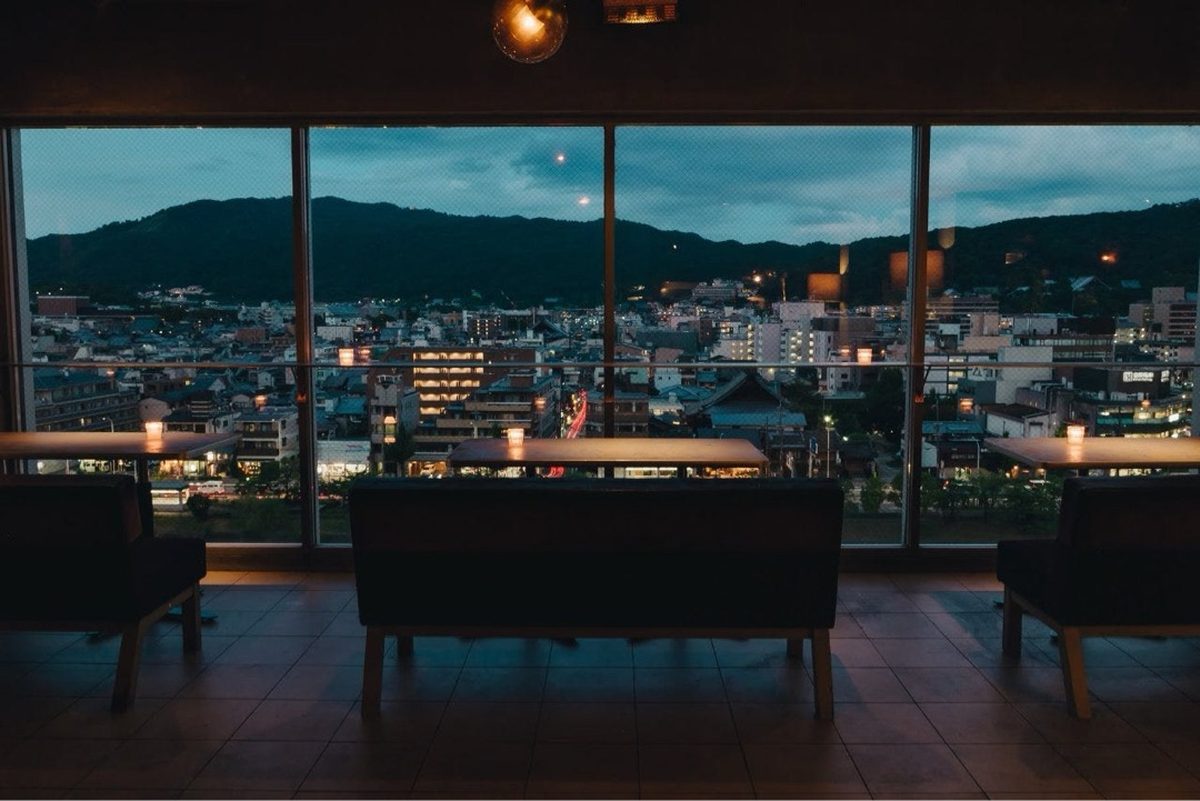
10th floor of the Empire Building, near the Sanjo end of Kiyamachi. Glass on three sides with views over the Kamo River and across to the Higashiyama mountains. The kind of place where you watch the light change over the city as the evening settles in.
The crowd skews young and local. Twenty-somethings and thirty-somethings, very few visitors from out of town. The food leans Italian: risotto, bolognese, ajillo. The cocktails are well made and the beer is cold. It’s not trying to be exclusive, it just happens to be hard to find. You take a nondescript lift to the top floor and the city opens up in front of you.
Good to know: No smoking indoors. Mon–Fri from 17:00, weekends from noon. Open until midnight. Beer from ¥700, cocktails from ¥1,000. No reservations needed on weekdays but weekends can fill up. Cash and card accepted.
→ Ace Cafe in the Kyoto Unknown app
CICON Rooftop Bar
6th floor of NOHGA Hotel, Kiyomizu Gojo. A more design-conscious rooftop with views of Higashiyama, Kiyomizu-dera, the Yasaka Pagoda, and Mount Hiei. There’s a fireplace surrounded by seating that makes the space feel like somewhere you’d find in Barcelona or Tel Aviv, except the view is of a thousand-year-old temple district.
The cocktails are the draw. An award-winning bartender runs the programme and the signature list changes seasonally. The food comes from a Josper charcoal oven downstairs, so the tapas are better than you’d expect from a hotel rooftop. Natural wines from Japan and abroad round out the drinks list.
Good to know: Open from 15:00 until midnight (food LO 22:30, drinks LO 23:30). Closed in rain. Can get busy on weekends. Walk-in only. Kiyomizu Gojo Station on the Keihan Line is the closest stop.
→ CICON Rooftop Bar in the Kyoto Unknown app
Izakaya and restaurants
Torisei Sanjo
A yakitori izakaya near Sanjo Station that looks intimidating from the outside but rewards anyone who walks in. The chicken is Kyo Akaji and Tanba chicken, both raised in Kyoto, grilled by someone with about 20 years behind the counter. The sauce is a secret recipe from the main Fushimi branch, cooked with sake from Yamamoto Honke, a brewery in Fushimi that’s been operating since 1677.
The signature dish is their tebasaki, deep-fried chicken wings with a light salt seasoning using Tanba chicken. Order those first. Then the yakitori assortment. Then whatever the veteran behind the counter looks like he’s enjoying making. The sake comes direct from the brewery, including their unpasteurised genshu which you won’t find in many places outside the brewery itself.
Good to know: Smoking is allowed, though ventilation is decent. English menu available. Counter seats and tables. Solo diners welcome. ¥1,300–4,000 per person depending on how deep you go. Credit cards accepted. A few minutes walk from Sanjo Station.
→ Torisei Sanjo in the Kyoto Unknown app
Onikai
Upstairs from a side street near Kawaramachi. An open kitchen where you can watch Kyoto vegetables being simmered, boiled, and transformed into dishes that make you reconsider what an izakaya can be. The vegetables come from their own contracted farms in Kyoto, delivered fresh daily. The counter is lined with produce stacked high in a rustic display of colour.
Order the omakase course and let them decide. The beef-wrapped grilled vegetables are the signature, but the simmered dishes and the seasonal rice are equally good. This is one of the best places in Kyoto for vegetarians who don’t want to eat at a specifically vegetarian restaurant. The food happens to be vegetable-forward because the vegetables are that good. This is exactly the kind of place we built the app to surface — high quality, locally rooted, and easy to miss.
Good to know: Reservations open 30 days in advance and fill fast. If you are more than 10 minutes late, your reservation is cancelled. This is a firm rule. ¥4,000–6,000 per person for the omakase experience. Counter seating is the best spot. No English menu but staff are accommodating.
→ Onikai in the Kyoto Unknown app
Isozumi
Same ownership group as Onikai, same farm, quieter execution. Where Onikai is energetic and buzzy, Isozumi is calm and considered. The focus is on ultra-fresh Kyoto vegetables and produce, presented simply. If Onikai is the night out, Isozumi is the dinner you remember. Ideal for two people who want to eat well without the volume.
Good to know: ¥2,000–3,000 per person. Reservations recommended. Shijo/Downtown area. A good option before heading to one of the bars below.
→ Isozumi in the Kyoto Unknown app
Jazz bars
Kyoto’s jazz bar culture has roots that go deeper than most visitors realise. In the 1960s and 70s, the city’s universities were at the centre of Japan’s student protest movement. The young radicals, dropouts, and intellectuals who drifted through that era needed somewhere to gather, and they found it in the kissaten, the traditional Japanese coffee houses that doubled as listening rooms. Vinyl records, cheap coffee, cigarette smoke, and hours of conversation. Jazz became the soundtrack, partly because of its association with counterculture and freedom, partly because the music rewarded the kind of close, quiet listening these spaces were built for.
Out of that era grew a jazz scene that still exists today. Kyoto is dotted with kissaten-style jazz bars, small rooms with serious sound systems where the owner selects every record and the etiquette is simple: sit down, order a drink, and listen. Some have been running for over fifty years. They aren’t performance venues with a stage and a cover charge. They’re intimate spaces where the music is the point and the bartender has spent a lifetime curating what you hear.
Here are two of the best.
Jazz Spot Yamatoya
Open since 1970. Down an alleyway off Marutamachi-dori, a few blocks east of Higashioji-dori, near Kumano Shrine. You follow a small sign that says “Yamatoya Jazz Spot” and it points you into a narrow passage. Inside is one of the most beautiful small bars you’ll find anywhere.
Victorian wallpaper, dark wood furniture, dim lighting. Over 5,000 vinyl records and an audiophile-grade sound system built around vintage Garrard turntables and large Klipsch speakers. The owner, an elderly man who has been curating this collection for over fifty years, selects every record himself. You can make requests. The coffee is made with fresh spring water drawn that day. The Ki No Bi gin and tonic, made with Kyoto-distilled gin, is one of the best long drinks in the city.
This is a listening bar. The music is played at a volume that allows conversation but makes clear it’s the main event. Small groups work, large groups don’t. Come here to slow down.
Good to know: Non-smoking, which is unusual for a jazz bar of this vintage and worth knowing. Cash only. Noon–22:00 (LO 21:30). Closed Wednesdays and Thursdays. No cover charge. Drinks are reasonably priced. A few minutes walk from Jingu-Marutamachi Station.
Jazz Cafe Rokudenashi
A different proposition entirely. South of Shijo on Kiyamachi, 2nd floor. 127 Saitocho, Shimogyo Ward. The name means “good-for-nothing,” a reference to the 1960s university dropouts who spent their time smoking and playing records instead of studying. The owner, Naoju Yokota, is a jazz drummer from Kyoto’s underground scene, and the bar has been running for nearly 40 years.
Where Yamatoya is refined and reverent, Rokudenashi is raw and chaotic. Records and bottles piled up, ashtrays, smoke, a counter where conversation with strangers happens naturally. The whisky highballs are cheap and strong. The music shifts from classic jazz to more experimental territory depending on who’s behind the bar and what mood they’re in.
This is not for everyone. If you’re sensitive to smoke or prefer a polished atmosphere, go to Yamatoya. If you want to feel like you’ve stumbled into someone’s living room at 1am and the records just keep playing, this is the place.
Good to know: Smoking allowed, and it’s not subtle. Reasonably priced drinks. Cash likely. Late hours. Small space that fills up quickly.
Cocktail bars
Finlandia Bar
Inside a former geisha house in Gion. Over 40 years old. Scandinavian-inspired minimalism downstairs, traces of the building’s geisha past upstairs. The bar also operates as a spirits import business, so the selection of gin, vodka, and distillates includes things you genuinely won’t find in other Japanese bars.
There is no menu. Sit at the bar, tell the bow-tied bartender what you like, and they make it. There is no music. At all. The only sounds are conversation, ice, and the bartender working. For some people this will sound like a nightmare. For the right person it’s one of the most atmospheric bars in Kyoto. The quiet is the point.
Good to know: Cover charge of ¥800. Smoking is allowed at the time of writing. Can get busy on Friday and Saturday nights, you may have to queue. Gion-machi minamigawa, Higashiyama-ku. Cash recommended. These are excellent bars and a cover charge of this level should not dissuade you from going, but we want this guide to be honest about costs.
CRAFT倶楽部
A cocktail bar in Gion that barely exists online. 173 followers on Instagram. No TripAdvisor page. No English-language coverage that we could find. This is the kind of place you walk past ten times without noticing and then someone who lives here tells you about it.
The cocktails are well made, the staff speak English, and the atmosphere is relaxed and welcoming. It’s a good place to end up when everywhere else has closed, because it stays open until 4am, which in Kyoto makes it practically nocturnal.
Good to know: Cover charge of ¥700. Higashiyama-ku, Gionmachi Kitagawa 347-98. Open from 20:00 until 4:00. Closed Sundays and holidays. Again, these are excellent bars and a small cover charge is standard practice in Kyoto’s smaller bars. We mention it because we’d rather you know before you sit down.
Scotch & Branch
A whisky-focused speakeasy entered through a British-style phone booth door. Inside it’s low-lit, intimate, and run by Daichi and Hidekazu, two bartenders who are genuinely passionate about what they do. The Japanese whisky selection includes rare bottles and they’ll walk you through flights and tastings if you’re interested. The cocktails are equally strong, particularly anything built around Japanese gin or bourbon.
Every review mentions how comfortable the staff make you feel, and in our experience that’s accurate. It’s a phone-booth entrance to a bar that’s anything but gimmicky once you’re inside. Mix of locals and curious visitors who’ve heard about it through word of mouth.
Good to know: Central Kyoto. Small, can fill up. Worth arriving earlier in the evening for a seat at the bar. Card and cash accepted.
How to plan your evening
The best Kyoto evenings aren’t planned tightly. Start with dinner at one place, walk to a bar, see where the night takes you. Here are three routes that work:
- The Gion crawl: Dinner at Torisei Sanjo, then walk south through the backstreets to Finlandia or CRAFT倶楽部. End at Rokudenashi if you’re still going.
- The quiet evening: Isozumi for dinner, then Yamatoya for jazz and whisky. You’ll be home by 10pm and it’ll be one of the best nights of your trip.
- The rooftop start: Ace Cafe from 17:00 for the light changing over the city, then dinner at Onikai (book ahead), then Scotch & Branch for a nightcap.
A note on cover charges and etiquette
Several of the smaller bars in this guide have a cover charge, typically called otoshi. This is standard in Kyoto and across Japan for intimate bars. It usually ranges from ¥500 to ¥1,000 and often includes a small snack. It’s not a visitor surcharge, locals pay it too. Think of it as the price of the atmosphere and the bartender’s time.
A few other things worth knowing: many smaller bars in Kyoto are cash only. Tipping is not customary and attempting it can cause confusion. If a bar is quiet, match the volume. And if the bartender looks like they want you to listen to the music rather than talk over it, they probably do.
Practical information
All details in this guide are based on our own visits over the past six months. Prices, cover charges, smoking policies, and opening hours reflect what we experienced at the time of writing. Things change, especially in Kyoto’s bar scene where places open and close quietly. If you’re making a special trip to any of these, it’s worth checking their social media or calling ahead to confirm they’re open.
The places marked with a link to the Kyoto Unknown app have full details, directions, estimated costs, and nearby places. The app is free forever, no ads, no tracking, and works offline, which is useful when you’re navigating backstreets after dark.
Download free on the App Store →
Frequently asked questions
Does Kyoto have good nightlife?
Yes, but it’s different from what you might expect. Kyoto isn’t a late-night city in the way Tokyo or Osaka are. Most restaurants close by 10pm and the streets quiet down early. But the bars, jazz cafes, and izakaya that stay open are often intimate, high quality, and rewarding for people who prefer a slower evening to a loud one.
What time do bars close in Kyoto?
Most bars close between 11pm and midnight. A few stay open later, particularly around Kiyamachi. CRAFT倶楽部 in Gion stays open until 4am, which is unusual for Kyoto. Plan your evening earlier than you might in other cities.
Do I need to speak Japanese to enjoy these bars?
Not necessarily. Several of the places in this guide have English-speaking staff or English menus. At the smaller bars where language is a barrier, a smile and a point at what someone else is drinking goes a long way. Bartenders in Kyoto are generally patient and welcoming even when communication is limited.
What is otoshi?
A small cover charge, usually ¥500–1,000, common at smaller bars and izakaya across Japan. It typically includes a small snack or appetiser. It’s charged per person and is standard practice, not a visitor markup.
Are Kyoto bars welcoming to foreign visitors?
The vast majority are. A small number of very traditional establishments in Gion and Pontocho operate on a referral-only basis, but these are rare and clearly signposted. Every bar in this guide accepts walk-in visitors and has been visited by us personally.
Is it safe to walk around Kyoto at night?
Kyoto is one of the safest cities in the world. Walking home at midnight through the backstreets is not only safe but one of the most peaceful experiences the city offers. The streets are clean, well-lit where they need to be, and quiet.
Can I combine the Sagano train and Hozugawa boat with an evening out?
Yes. The boat arrives in Arashiyama in the late afternoon. Take the train back to central Kyoto and you’ll be in time for dinner at any of the restaurants in this guide. The Torisei and rooftop bar route works well after a day in the gorge.
Related reading
- Why we built Kyoto Unknown — the thinking behind the app and the distribution problem Kyoto’s nightlife benefits from solving.
- The free app for finding the Kyoto you came here for — full walkthrough of every feature in the app, including the places in this guide.
- Golden Week in Kyoto 2026 — if you’re visiting during Golden Week, the rooftop bars and evening restaurants in this guide are when the city is at its best, after the day-trip crowds leave.
- Sagano Train & Hozugawa River Boat — the best day trip in Kyoto, pairs well with an evening out.
- Aoi Matsuri 2026 — Kyoto’s oldest festival on May 15. Two of the shrines in the procession, Shimogamo and Kamigamo, are among the quietest spots in the city the other 364 days.
- How to Explore Kyoto on Your Own — 2/3/5-day itineraries that include the evening spots in this guide.
- Every place in Kyoto Unknown — the full list.
Need help? Contact us →